




This story originally appeared on the Gents Cafe Newsletter. You can subscribe here.
In a culture built on speed, smoothness, and frictionless digital efficiency, choosing to slow down feels almost rebellious. For decades, I lived at a city tempo; London, Birmingham, New York: fast, wired, relentlessly forward. Somewhere along the way, the endless scroll flattened my days into one indistinguishable stream. I found myself reaching for something with edges. Something with weight.
That’s where analogue entered. Not as nostalgia, but as a recalibration of attention.
Friction as Philosophy
Digital life is infinite. The feed never ends, playlists never stop, and nothing truly ages. Digital files don’t acquire history; they simply corrupt. Physical objects, by contrast, accumulate patina. The brassing on a black-paint Leica, the softening of a leather notebook cover; these marks of use become a quiet autobiography. Psychologists call this psychological ownership: the sense that an object isn’t just owned, it’s part of you.
Analogue objects aren’t passive. They demand attention. In doing so, they create autonomous time, time that is self-justifying, not merely a means to an end. You can’t rush a turntable or accelerate a chemical reaction in a darkroom. You surrender to the inherent pace of the object.
And in that surrender, something extraordinary happens, you reclaim sovereignty over your attention.
The Ritual of Sound
In the streaming age, music is accessed, not owned. It becomes background noise; algorithmic, endless, frictionless. Vinyl is the opposite. It insists on ritual: sliding the record from its sleeve, lowering the needle, accepting the crackle and hiss as part of the story.
Because a record can be lost, scratched, or destroyed, it becomes precious. That vulnerability heightens its value. Flipping through crates is a genuine treasure hunt, lighting up parts of the brain no algorithm ever could. Vinyl restores the feeling that this is mine, with it comes deeper listening.
“If you ever get lonely, just go to the record store and visit your friends.”
The Architecture of Thought
Writing with a pen is not faster or more efficient than a keyboard. It is, however, more human.
“An elegant weapon for a more civilized age.”
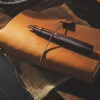
I’ve kept a notebook and pen close for over a decade (this article began life on paper). The glide of nib across page anchors ideas in a way typing never does. Handwriting demands presence, activating neural pathways linked to cognition, creativity, and clarity. It creates room for thoughts to stretch and unexpected connections to form.
The notebook ages with me. Dents, stains, softened corners, a tactile history digital documents can’t replicate. But the real magic comes from surprises that aren’t mine. My young son will sometimes pull the notebook close, carefully adding a drawing, a letter of his name, a sticker placed with total seriousness.
Weeks later, I’ll turn a page and find one of his contributions, a small burst of joy preserved in ink and adhesive. Digital notes can be synced and searched, but they never surprise you.
Analogue objects invite memory to settle in the margins.
Memory Made Material
Digital photography gave us convenience, but at a cost. We now produce thousands of images destined to disappear into the endless scroll, stored, but not remembered.
Film offers a counterpoint. I often shoot with a 1950s Leica M3 or a Rolleiflex from the same era, cameras built with an intentionality bordering on reverence. Their limitations become virtues: limited frames, manual focus, no instant playback. Each frame is a decision. You pause. You judge. You commit.
“No one ever takes a photograph of something they want to forget.”
A physical print has weight. Texture. Presence. It becomes an artifact, something that will outlast operating systems, platforms, and cloud subscriptions. A legacy future generations can literally hold.
A Quiet Act of Rebellion
Choosing analogue isn’t a rejection of modern life. It’s a reminder that limits can be liberating. That objects with history create continuity in a world obsessed with immediacy.
P.S. Can you name the films the quotes are taken from?


