




This story originally appeared on the Gents Cafe Newsletter. You can subscribe here.
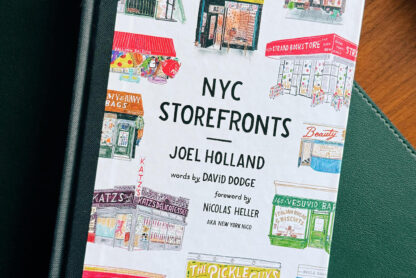
The value of a coffee table book doesn’t just lie in its design or materiality, but in the history and significance it carries within: stories of brands, people, and destinations brought to life with skills and passion.
We sat down with Raoul Visendi, Chief Marketing Officer of Grafiche Milani, to discover the philosophy behind one of the world’s most respected printing houses, one where the human experience built over more than a century intertwines with the most advanced machinery.
In this Scent of Paper interview, Raoul took us through his journey at the company—from his earliest memory at the workshop to the challenges that every new project brings.

What is the most vivid memory of your entrance into the company, and what did it mean for you to confront an inheritance so dense with memory?
I still remember my first day. When I walked in, the smell of ink and paint was just striking. It’s something I’ve never forgotten; it is a very strong smell at first, one of those aromas where you just stop and say, “Wow.”. Eventually, you get used to it, but walking into those scents is quite a shock initially.
Then, above all, there was the smell of paper. I’ve always been a history lover, I already collect books on my own, and while I appreciate technology, I really love the history and the tactile experience of touching a book. Seeing the paper was deeply moving for me: these columns of paper look like white pyramids standing in the middle of a warehouse. It immediately reminded me of that exhibition with those impressive, tall columns by Anselm Kiefer at HangarBicocca.
Right then and there, I also understood that this is a company intertwined with Milanese history. It is an institution that has chronicled the stories of incredibly important figures. I somehow perceived that in the exact moment I arrived, and it truly helped me set my pace inside the company.
This is a company intertwined with Milanese history. It is an institution that has chronicled the stories of incredibly important figures.
What was your background before joining the company, and how does it influence your creative vision within Grafiche Milani?
I studied fashion and worked in the industry in product development for a long period, first for Vivienne Westwood, and subsequently for other big fashion brands. I had both an office job in London and a more hands-on period in Italy, and witnessing that behind-the-scenes world was incredibly educational and exciting for me. Furthermore, my family has deep roots in fashion; the Visendi family actually founded Roberta, an Italian underwear brand that was eventually sold in the early 2000s, so fashion has always been a constant topic of conversation at home; my father is a true enthusiast, so for us, fashion was simply our daily bread.
My involvement with Grafiche Milani began gradually in 2022: I stepped in initially as an advisor, then became a shareholder, and eventually took on the role of Chief Marketing Officer. If you look at how we have managed the company’s identity, you can see our approach is treating it like a fashion brand that happens to print. Applying this perspective to the printing sector was initially shocking because absolutely no one had done it before. However, once the vision came to life, it was incredibly well-received. It allowed us to speak directly to the end consumer by revealing the behind-the-scenes world of publishing and printing. Unlike the fashion industry, which is highly publicized, the printing sector has traditionally been completely closed off within itself, so this was a welcome change.
To the average person, printing doesn’t even appear cool unless you happen to be a bit of a nerd about these things, like me. People usually view it as something purely technical, and while they find the final book amazing, they don’t look at the industry itself as attractive. We wanted to change that, and worked to make the backend of the sector truly appealing, especially for the younger generation. For generations, craft trades were dying out because families stopped passing down the knowledge, social dynamics shifted, and everyone pursued university degrees while forgetting about practical, physical craftsmanship. It’s a matter of making these traditions and jobs appealing again.

Is there a specific sound, smell, or corner within the company that manages to move you every time, as if it were still your first day?
What truly gives me excitement and energy is that in our sector, what we create is different every single time. We do not have a continuous, standard product; everything is highly customized, and it changes entirely depending on the client. Each time it is a new challenge and a new narrative, which ensures you never get bored.
When it comes to doing business and optimizing, the usual tendency is to create a standard product that can be scaled. However, we intentionally choose not to standardize because our clients specifically ask us not to be ordinary. That is what makes Milani significant. We moved away from classic editorial reading materials twenty years ago, recognizing that traditional newspapers—the kind read by our fathers or grandfathers—were losing their appeal and sales. Today, an entirely different product is being sold: design books or “coffee table books”.
Today, our product sits squarely between industrial manufacturing and artisanal craftsmanship. Our greatest challenge is to balance that: it is our beauty. Yet, in a world that is becoming increasingly uniform, there is more and more value in this. We are seeing a complete U-turn with the newer generations as well. The digital space is becoming the “fast fashion” of information—it is what we use every day, just like artificial intelligence. Meanwhile, luxury is shifting entirely toward a physical experience.
Can you tell us how a new book comes to life? Which are the most delicate steps, and which, instead, are the most fascinating?
Every project originates from the client’s idea. It always begins with them, and from there, we determine whether they already have a clear vision or if we need to guide them. If guidance is required, we naturally try to provide it. I always use the analogy of lawyers: as a client, you bring the problem based on your understanding, but it is up to the lawyer—in this case, Milani—to advise you, whisper the right solutions, and direct you toward the best approach practically, economically, and physically for the product itself. We always aim to accompany the client, starting from their initial concept or developing an idea together with them.
The most difficult part is the initial concept itself because clients often start with an incredibly complicated idea. We then have to figure out how to realize it practically, which is frequently where the product development phase comes into play. Product development is one of our core strengths—translating a creative concept into an actual, practical object. Once you understand the prototype and the mechanics of how it will be made, you move on to the industrial manufacturing stage.
Regarding the choice of materials and components, we always try to give the product a distinct appeal. Personally, I always try to push innovation with my clients. Of course, it is ultimately the client’s choice whether to accept it or not, but the goal is always to create things that are entirely feasible yet completely out of the ordinary. Milani’s ultimate objective is to present a project to the client that makes them say “wow”: that is exactly where the emotion lies.
Milani’s ultimate objective is to present a project to the client that makes them say “wow”: that is exactly where the emotion lies.
Today, technology offers highly sophisticated automatic controls, yet you maintain that “nothing can replace the human eye.” At what moment in the production process does the artisan’s intuition still make a difference?
The level of precision offered by modern machinery is certainly impressive; it has completely removed many inconsistency and production issues. However, the human eye remains unmatched. To give you a very practical example: black seems like an easy color, but it is actually the most difficult to manage because it has various nuances. If you want to achieve a truly deep black, you need the human eye. Digital systems and machines cannot achieve this or determine it for you; only a trained eye can do it. The same applies to many other colors. It is one thing to view a color on a computer screen and another to see it on the machine.
Ultimately, a human is required to truly understand what color the client expects. A “famous” color like Tiffany blue might seem straightforward, but it is incredibly difficult to reproduce. The client company is naturally very precise in providing us with the exact color codes, but the final output changes completely from one material to another. It is like using the same printing mold on wood versus metal, and a change is noticeable even on very similar paper stocks, for example if one is thicker and the other is thinner. The machine will tell you, “Yes, it is identical,” but it does not account for the underlying material. Only a human can truly understand the material’s impact.

Can you take us behind the scenes of a particularly complex project you have completed?
For me, the most fascinating project is the one we did for Bombardier, the private aviation company. One of their ambassadors is Toto Wolff, the Team Principal and CEO of the Mercedes Formula One Team. As an ambassador who exclusively flies Bombardier, he initiated the concept for this book, and pitched us a book to chronicle the company for their top clients.
We started with numerous ideas and ultimately got to the final concept of using actual aircraft sheet metal to construct the book. The result is exceptionally beautiful—very minimalist, yet visually striking. The exterior case features the aircraft metal sheets, while the internal case and the book cover itself are crafted from carbon fiber, and all the components match perfectly.
Developing the entire project took a year and a half: naturally, refining such a distinct idea and putting it into practice requires significant time, and our product development department frequently collaborates with external artisans. The main challenge lies in the sourcing process—specifically, finding an artisan who understands how to manipulate sheet metal and steel for a product like a book. It requires merging our printing expertise with the steel artisan’s technical skills to create an entirely new product that neither side has executed before.
Beyond that, some of the recent projects we have realized include a book on Venice and one on Versailles. The Versailles volume is particularly special because it features a custom wooden case designed in collaboration with the artist Jeff Koons. The interior is very characteristic of his aesthetic and looks just like a painting. The Venice book is our latest project in terms of scale; we produce books in four distinct dimensions, the largest of which is a 1.20-meter format we call the “Big Brother.”
We also worked on a project for Michael Jordan in collaboration with Assouline. It features a stunning presentation base designed to hold a replica of his championship rings, which incorporates a printed signature, with the book resting right on top. That specific project was a triangular collaboration between Jordan’s team, Nike, and Assouline. We often navigate these complex three-party dynamics—similar to what we do with Loro Piana or Louis Vuitton, where you have the founding family, the corporate group, and the publisher all involved.

A prestigious book is a “slow” object in a fast-paced world: how do you think the physical act of turning a page changes our relationship with the content and with time?
I always use a specific example. Why does someone buy a Birkin bag? You buy it because it tells a story, because it is beautiful, because someone influential owns it, or because it represents something meaningful. The same principle applies to a book. We communicate our identity through our legacy—for instance, by sharing that we have produced books for the White House or for international projects. You are not merely purchasing a beautiful aesthetic object; you are acquiring the rich history behind it, knowing that some of the most prominent figures have come to this company specifically to bring their visions to life. Our goal is to tell that underlying story.
Fortunately, this approach is more relevant than ever today because physicality is making a strong comeback. Being able to rely on this narrative is crucial now, particularly as the luxury world faces challenges that often arise because brands struggle to adapt or simply do not know how to communicate who they are in a clear, straightforward, and authentic way.

Which coffee table books do you keep at home?
Even though it’s not printed by us, I must confess that one of the most beautiful books I own is a book on the works of Helmut Newton. Another one of my favorite authors is Albert Watson. We have actually worked with Albert many times and have produced books for him on various occasions.
I also really like the book we produced for Loro Piana, a very extensive project focused on their cashmere. I actually own the special, numbered edition, which shares the content of the “regular” edition but incorporates the actual raw cashmere veil provided by Loro Piana. The challenge was finding a way to embed it into the cover. Because the cashmere fibers were so long and delicate, they couldn’t feed through our standard machinery, making them incredibly difficult to encase without ruining them.
Additionally, we print the books directly for Louis Vuitton. Many people don’t realize that Louis Vuitton operates as an actual publisher with three distinct book lines, including their Fashion Eye photography series. I have one of those at home as well: I am a passionate photography lover, and the volume I have features the work of the late Frank Horvat, who was a true revolutionary. He traveled extensively through China and Asia in the 1940s, capturing a world that had rarely been seen.
To celebrate your 120th anniversary, you created a volume about your history. What was it like to experience being the protagonists of the book you were printing, and what message do you hope it conveys?
It was incredibly moving because, for the first time, we weren’t just looking at the work from behind the scenes. Positioning ourselves as the subjects and protagonists was deeply gratifying and allowed us to view ourselves under an entirely different light. For the employees themselves, it was exceptionally rewarding. It was also wonderful to draw our staff out of their shells; people in this industry tend to be very reserved, so encouraging them to open up was challenging but ultimately beautiful.
The significant purpose of this book is to chronicle the printing sector itself—and we are the only ones telling this story—in a highly authentic and transparent manner. That was our precise objective: to recount the journey of a company that has narrated the history of Milan, documented highly prominent figures globally, and, above all, defined what printing truly is. These are the three central pillars we wanted to convey with this volume, using a very straightforward approach.
We joined forces with CB Hoyo as I have long been a fan of his works. I followed him online and always appreciated his penchant for provocation. I thought, why not merge this highly contemporary, powerful, artistic vision with the classic nature of Milani to create a unique mix? Initially, no one believed it would work, but it was ultimately successful.
Our relationship with him was very relaxed and fluid. He fully understood what we wanted to achieve: to express physicality and the deep appreciation for that tactile experience. He ended up creating a phrase that has practically become our corporate motto, “Love Needs a Physical Form”; the women in our quality control department even had it printed out for themselves. It was incredibly well-received.

Outside of your everyday life at Grafiche Milani, what captures your time and interest?
My two great personal passions are photography and music. I really enjoy taking photos when I travel, and in the past, I used to be a DJ.
One thing my time as a DJ definitely taught me was how to communicate with many different people. Nightlife is a strange thing, but it allows you to connect with people in a completely different, even more intimate way than during the day. DJing is also very similar to what we’ve done with CB Hoyo here at Milani: it’s about mixing elements together. Sometimes a mix works perfectly, sometimes it doesn’t, but the act of mixing frequently brings about something entirely novel. Today, creating something completely new from scratch is incredibly difficult, but mixing existing elements often results in true innovation.
As for photography, I am a highly visual person; I rarely remember names, but I always remember images. I possess an entirely visual memory, which helps immensely with photography. It’s a true creative outlet for me—when I travel, I always bring my Leica along to shoot. In terms of style, I really appreciate portraiture and capturing people. At first, I actually disliked taking photos of people and found it tedious, but then I realized it came to me automatically, and I loved how the results turned out. Photography, for me, is entirely about human connection.
Now, I would like to start shooting on film to cultivate that same physical, tactile atmosphere in photography that I work with every day in books. Digital is beautiful and convenient, but I want to deal with the roll of film and the actual printing process. Moreover, with a roll of film, if I mess up a shot, I only have that one exposure anyway, and that’s it. If I take it well, great; if not, so be it. It forces me to go about it with a more relaxed, spontaneous mindset. Digital photography allows everything to be perfect—you overthink the color, the composition, the light. It’s beautiful, but it lacks spontaneity. With film, even a flaw or an imperfection becomes its added value. It captures the authentic moment exactly as it was when you saw it, rather than a forced, sterile perfection.