




This story originally appeared on the Gents Cafe Newsletter. You can subscribe here.
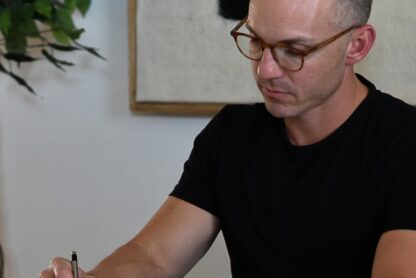
Meet Cameron Engle (@cammengle), a craftsman, writer, and dedicated father based in Fishers, Indiana, who runs a residential design business with his wife, while also ghostwriting for brands. He also runs a newsletter for dads, encouraging fellow fathers to engage in “analog moments” with their children. Cameron is deeply devoted to the crafts of writing, woodworking, and, above all, parenting, which he views as the greatest legacy he can leave. His philosophy centers on anchoring his life and business around connection and agency—the freedom to choose, to make, and to create—prioritizing “time wealth” over the traditional grind.

What are your main passions and how do you cultivate them?
My primary passions are parenting, craftsmanship, and the intertwined world of reading and writing. Parenting might sound like an unusual choice for a “passion,” but I truly view being a father as a skill or a craft to be honed. It isn’t always natural; it’s something you must consciously develop and improve upon over time. I read and think about it more than almost anything else, and I am deeply proud of how I’ve grown in that role. While some might see children as a hurdle to their personal dreams, I find the challenge incredibly rewarding. To me, the greatest legacy I can leave is the memory my kids will have of me being a good dad.
When I need mental space, I retreat to craftsmanship. I love working with my hands, particularly woodworking and tile work. When approached with care and a commitment to quality, both are genuine art forms that require patience, and I see them as lifelong pursuits that I will continue to study and attempt to master for the rest of my days.
Similarly, I’ve always found a home in writing. I’ve always said I’d rather write a paper on any subject than solve a single math problem; I enjoy the fluid process of expressing an idea rather than the rigid certainty of a numerical result. A few years ago, I decided to dedicate my life to these two crafts—writing and woodworking—with the hope of passing them both down to my children.
To me, the greatest legacy I can leave is the memory my kids will have of me being a good dad.
How did you first develop an appreciation for style?
My relationship with style started with a strange obsession when I was in elementary school. I was fixated on those cinched-bottom jeans and, according to my mother, I would throw huge fits if I wasn’t wearing them. None of the other kids wore them, but even then, I had a very specific idea of how I wanted to present myself.
As I matured and moved through those typical school phases of trying to fit in, my appreciation for style evolved into what I now call “elevated function.” I want what I wear to perfectly suit the environment I’m in. I’m not a fan of the modern trend of “do-it-all” clothing that claims you can wear the same piece from the beach to a boardroom.
In the shop, my style is a mixture of rugged durability and intentional presentation. I’m often in the middle of messy projects, so I need clothes that can handle the wear and tear of craftsmanship, but I still want to show up in that space looking well put together. Growing up in a small town, it was always very clear who belonged to which crowd, and dressing intentionally became a way for me to distinguish myself and express who I was.
While many people stopped caring about their appearance as they got older, I found that maintaining a sense of style was a powerful way to navigate different worlds while remaining true to my own identity.
What does “being well-dressed” mean to you?
To me, it is about meeting the requirements of an occasion or an activity, but doing so at a higher level than what is strictly expected. It’s about being distinguished. If I’m attending a wedding or a cocktail event where there is a clear, almost uniform-like dress code, I want to fit into that environment while simultaneously pushing the boundaries of what is “normal” just a little bit.
I like the challenge of taking a standard silhouette and finding one unique element—whether it’s the way I cuff my trousers, the specific texture of a tie, or the cut of a suit coat—that makes the look feel entirely my own. Of course, life with three young kids means I’m not exactly “James Bonding” through a crowded schedule of high-society parties every night. My daily reality is much more grounded.
However, on those occasions when my wife and I do get invited out as a couple, I still approach my wardrobe with that same intentionality. I ask myself how I want to feel in that space and how I can honor the event while remaining individual.

Where do you primarily draw your style inspiration from?
Lately, my inspiration has been coming almost exclusively from the “maker” and creative craft worlds—people who are knee-deep in their trade but still maintain a very distinct, intentional sense of style. I’m drawn to creators who manage to look sharp while they work, balancing the grit of the shop with a refined aesthetic.
One person I follow closely is Dean Petty; he owns a coffee shop and a pizza place, and there’s something about his effortless, creative approach to his daily look that really resonates with me. However, if I had to point to one major North Star for my personal style, it would undoubtedly be Huckberry. They’ve mastered that specific mixture of urban adventure, maker culture, and timeless style that I strive for in my own wardrobe.
Another significant influence is Thom Hill, the founder of Iron & Resin. I love the way his style blends the atmosphere of a grease-stained garage with a “Baja adventure” meets relaxed lifestyle vibe. It’s rugged, functional, and yet completely polished in its own way. Of course, in our modern digital landscape, these aren’t people I know personally; they are just individuals I observe through the rectangular brick in my hand. But seeing how they navigate their crafts while staying true to a specific look helps me define how I want to show up in my own workshop and my own life.
How do you define success, and what motivates you to achieve it?
Over the last decade, my wife and I have radically redefined what success looks like. We’ve moved away from the traditional Western “grind”—the constant climbing of ladders and monetary obsession—because it simply isn’t attractive to us. Instead, we’ve anchored our lives around two core pillars: connection and agency. I believe humans are fundamentally wired for connection, yet it’s the thing we’ve most neglected in this digital age. For me, a successful day is one where I have truly shown up and connected with my wife, my children, or my friends. If I’ve missed those relational moments, the day feels incomplete, regardless of what else I’ve accomplished.
The second pillar, agency, is the ability to choose, to make, and to create. This is the heartbeat of our business. We wanted to build something together that didn’t exist before, creating a legacy that we can eventually invite our children into. We prioritize “time wealth”—the freedom to have slow mornings when the kids need them or to be home when they get back from school. We wouldn’t trade the relational wealth we’ve gained with our children for any financial position, because those deep connections are things we’re learning to cultivate in a way that feels entirely new and vital. If I feel something is impinging on my agency or if I’ve failed to connect, then I haven’t met my own definition of success.
We prioritize ‘time wealth’—the freedom to have slow mornings when the kids need them or to be home when they get back from school.
What’s the next destination on your bucket list?
For my 40th birthday, my wife surprised me with a five-day solo hike along the western coast of Spain, a segment of the Camino de Santiago. I’ll be flyng into Porto, Portugal, staying for a night to soak in the atmosphere, and then heading up to Tui to begin the trek toward Santiago de Compostela. I’ve felt a pull toward Portugal for a long time, and while I’m an avid hiker and love adventure, I’ve never actually embarked on a solo pilgrimage like this.
The timing feels significant; I leave in about six weeks, so the anticipation is starting to build, and I’m already looking forward to the mental space that a solo journey provides. In a life filled with the constant noise of a business and a busy household, the idea of a quiet trek through the Spanish countryside is the ultimate gift. I’m looking forward to that specific brand of solitude where the only goal is to put one foot in front of the other and see where the path leads.

Is there an object or piece of craftsmanship in your life that holds deep meaning? What makes it special?
I lost my father to suicide about three years ago after he had struggled his whole life with addiction and depression. It was unexpected and tragic, and a few days after he passed, my brother and I went to clean out his apartment. In his garage, we found a massive box containing about 120 vinyl records from the 70s and 80s.
My dad was a massive lover of classic rock and roll; I remember being a kid and hearing the music blaring from the street as I walked home from school. Those records are incredibly special to me now. During the first few months of my grieving process, I would just sit in my garage with a record player and listen to them. He wasn’t a perfect man, but he passed on a genuine love of music that I still carry with me every day.
Alongside the records, I inherited a red Van Halen guitar with white stripes—the iconic “Frankenstrat” look—that he had kept for years. I eventually asked my mom about its history, and she told me he had actually built it himself for a Halloween costume one year. I never knew my father was handy with woodcraft, as I mostly remembered him being good with cars. It might not be the highest level of professional craftsmanship, but having something he built with his own hands is priceless to me. It gives me a way to talk to my kids about their grandfather, since they were so young when he died. I can show them the guitar and tell them, “He loved music, and one day I’ll play these records for you.” These pieces are now emotional anchors that keep his story alive in our home.

If you have made a significant career change, can you describe it? What motivated that decision?
For about ten years after college, I worked for a nonprofit. While there were good moments, the experience eventually turned out to be quite toxic and traumatic. When my wife and I finally decided to leave St. Louis and move back to Indiana to be near family, I realized I didn’t have many marketable skills. The nonprofit world had demanded my entire life, but it hadn’t provided a resume to fit the “real world” or the things I actually wanted to do. I floundered between jobs for a while, even starting grad school to become a high school counselor, before landing a corporate role as a copywriter for a marketing firm. It was a very typical office setting—writing cold emails for industrial manufacturers—and while it paid well, I felt the disconnect of sitting in front of a screen all day.
My wife and I have always been a “weird” couple in that we actually love being around each other as much as possible and dreamed of building something together. She had already launched her own residential design business, and we thought maybe I’d join her in ten or fifteen years once it grew. However, a project came in three years ago that required craftsmanship skills I had been developing on the side, and we decided to take the leap right then.
We went “all in” on ourselves, trusting that we could create a life on our own terms. It was the biggest risk I’ve ever taken, but it’s also the most I’ve ever enjoyed working. Transitioning from pure “brain work” to physical labor has been a vital shift for my mental health, allowing me to find a flow state that I never found in an office.

What are your three favorite books and why?
Choosing only three is incredibly difficult because reading is such a core part of my life, but these are the titles that have stayed with me the longest.
This is Happiness by Niall Williams. He is an Irish author, and the book is written with such beautiful, slow-paced prose that it has become perhaps my favorite book of all time. It’s a quiet story, but the way he handles language is just masterful.
Blindness by José Saramago. His writing style is wild because he almost entirely abandons traditional punctuation. When you first start, the first 50 to 75 pages are an uphill battle as you try to figure out where one character’s dialogue ends and another’s begins. However, once you settle into his rhythm, it becomes an incredible piece of social commentary.
Lonesome Dove by Larry McMurtry. I had never really explored the Western genre before, and even though it’s a thousand-page doorstopper, I felt a genuine sense of loss when it ended. I wanted to go back to that world so badly that I immediately started the rest of the series.

What are your three favorite brands and why?
Iron & Resin. I mentioned their founder earlier, but the brand itself hits on every value I hold dear—craftsmanship, freedom, durability, and a rugged outdoor adventure aesthetic. I’ve been particularly impressed by their editorial and documentary-style videos lately. Besides clothes, they sell a philosophy of quality and independence that resonates with anyone who spends their days in a workshop or out on the road.
Notes Running. This is a newer find out of Australia that focuses on “analog running culture.” The founder writes poems that become the monikers on his shirts and the core of his online presence. It’s a refreshing “anti-track” movement—the idea is to go for a run and not tell anyone how fast or far you went. As someone who naturally tends to track my runs and push for improvement, I love this brand because it challenges my instincts and reminds me that running should be about the person, the connection, and the moment, rather than just the data.
Stovetop Roasters. I am a self-confessed coffee snob, and while Stovetop makes a truly great product, my loyalty to them is rooted in a core family memory. When my wife and I were making the massive decision to start our business together, we took a vacation with our kids to Holland, Michigan. We have a tradition of finding local roasters whenever we travel, and Stovetop was the first one we fell in love with during that special time away. Now, we have a subscription at home, and every morning that coffee brings us back to the lake and that pivotal moment in our family’s story.