





This story originally appeared on the Gents Cafe Newsletter. You can subscribe here.
Josh Conley (@joshbconley) is a Memphis-based entrepreneur and the creative force behind the upscale cocktail bar, Bar Limina. A dedicated “cocktail nerd” and the founder of the Etowah Collective, Josh balances his professional obsession with the craft of mixology with a deep-rooted love for literature, gardening, and the intentionality of fatherhood. He approaches his work with the belief that life is a compilation of distinct seasons, viewing the quiet moments of “thinking and chewing” on an idea as a vital part of the creative labor itself. You’ll rarely find him without his fifteen-year-old Filson tote or his daily journals, where he meticulously leaves a trail of thoughts and observations for his son to discover one day.
What are your main passions and how do you cultivate them?
I’m a cocktail guy, so I tend to get pretty nerdy about them. That’s really what drove me into the food and beverage world and what has kept me anchored there for a long time.
Back in college, while everyone else was focused on cheap beer or Jägerbombs, I fell in love with the craft. I started experimenting at home, making elevated drinks for my friends when we were 20 or 21. It became this “magic trick” I could do that nobody else my age was really doing. That initial obsession led me to writing about spirits, consulting on various projects, and eventually navigating the industry to open my own space.
Last May, we finally opened the permanent version of Bar Limina in downtown Memphis. It’s a technique-driven, ingredient-focused upscale cocktail bar. It’s the culmination of years of pop-ups and refining my craft.
I’m also a big reader, and I’ve found that all my passions tend to feed each other. Inspiration for a new drink or a service detail often comes from a book I’m reading or time spent outside. My wife and I grow a garden every year, which keeps me connected to the seasons and the raw ingredients we use.
Beyond the bar, my biggest focus is my three-year-old son. I’m incredibly passionate about being a present father and making sure he grows up to be a good person. Between the garden, the books, and the family, I try to keep a balance that allows the creativity at Bar Limina to stay fresh.

How did you first develop an appreciation for style?
It all ties together, doesn’t it? If you appreciate the lines of a well-tailored jacket, you’re probably going to appreciate a great piece of furniture, too. For me, that aesthetic curiosity was sparked by reading, and I owe a lot to Monocle. I started reading the magazine years ago and diving into the various publications they put out. It opened a window into a world where design and quality mattered across the board.
But if I have to pinpoint a specific moment when my interest in style started, it goes back to my college days. I’m not entirely sure what inspired the purchase, but I ended up with this really nice brown tweed sport coat from J.Crew made with Abraham Moon fabric.
That jacket was the turning point. It was the first article of clothing that made me feel like Superman the moment I put it on. I wore it constantly. Once I had that one “anchor” piece, I started paying attention to everything else. I began thinking about how to find better jeans or what specific shade of denim would best complement the tweed.
It wasn’t just about the clothes themselves; it was about the confidence they provided. That single jacket shifted my perspective from just wearing “stuff” to building a wardrobe with intention. It’s a feeling I try to replicate now in the atmosphere of Bar Limina: that sense that when the details are right, you just feel better.

What does “being well-dressed” mean to you?
For me, being well-dressed is about high-quality simplicity. I build my entire wardrobe around the best pieces I can get my hands on, but with one major caveat: nothing can be too precious.
My day-to-day life is a constant shift between environments. I might start the morning in a meeting with a potential investor, spend the afternoon crawling around a kitchen floor trying to fix a stubborn refrigerator, and then head straight into a high-end service at the bar. I need clothes that can navigate all of those worlds without me having to worry about them.
If a garment is so delicate that I’m afraid to get a splash of gin or a bit of dust on it, it doesn’t have a place in my life. To me, “well-dressed” means wearing items that gain character through use. Whether it’s a heavy-duty flannel, a pair of boots, or a jacket in a resilient fabric, the focus is on the construction. When something is truly well-made, it performs better.

What’s the best piece of advice you’ve ever received, and who gave it to you?
I actually have two, and I can’t say which one has been more impactful on my approach to life and my business. Both came from people I deeply respect, and both provided me with a similar sense of freedom.
The first came from a close friend, hunting companion, and pseudo-mentor, Tyler White. A few years back, I was agonizing over a potential job change. I was talking through the risks when he told me: “Life is a compilation of seasons, and it’s okay if those seasons are brief.”
That one sentence gave me the permission to be riskier. It taught me that the things you work on or the decisions you make don’t always have to be permanent to be valuable. There’s a common quote that says “failure doesn’t exist if learning is the goal,” and I think Tyler was hitting on that same truth. You can build these different, sometimes short-lived experiences on top of each other, and together they create the full tapestry of your life and work.
The second piece of advice came from a professor during a time when I was feeling a lot of anxiety about a looming deadline. I’ve always been someone who works in bursts, and for a long time, I felt like a procrastinator because I was slow to put pen to paper.
My professor asked me, “Have you been rolling the project around in your head? Have you been thinking through how it’s going to come together?” When I said yes, they told me: “That is the work, too.”
Especially in creative or written work, the process starts long before you produce something tangible. Thinking is working. That realization freed me to embrace my natural style. Even now, when I’m developing the concept for Bar Limina or a new menu, I spend a lot of time just “chewing” on an idea. To an outsider, it might look like I’m doing nothing, but I’ve learned to trust that the thinking is just the foundation for the burst of productivity that follows.
“Life is a compilation of seasons, and it’s okay if those seasons are brief.”
What’s a brand (not necessarily menswear-related) that embodies your idea of quality?
For me, quality is defined by longevity and the ability to move between vastly different worlds. For this reason, I am a big fan of Filson, the epitome of “rugged but polished.” I carry a Filson zip-top tote every single day of my life.
What I love about it is the versatility. This is the same bag I use to carry my laptop to business meetings, yet it’s also the bag I’ll toss into a duck blind during a hunting trip. After fifteen years of constant use, it could probably use a bit of a re-dye, but functionally, I don’t see it wearing out anytime soon. It’s a piece of gear that refuses to quit, and that, to me, is the ultimate mark of quality.
Another brand I deeply admire is Sid Mashburn. I love Sid’s approach to products; everything feels incredibly intentional and hyper-curated. He has this rare talent for telling the story of a garment’s provenance in just fifteen words, explaining exactly why it matters and why it earns a spot in his shop.
But beyond the elegance and the curation, he doesn’t seem to take himself too seriously. There is a sense of joy and playfulness in the brand that is incredibly refreshing in the world of high-end menswear. It’s that combination of being “all-in” on the details while maintaining a light heart that I find really inspiring.
What does your ‘daily uniform’ look like?
I’m a noted uniform wearer. My daily look is built on a foundation of classics: it’s always chinos and an OCBD shirt—I’m a sucker for a good button-down collar. Usually, I stick to shades of blue or blue patterns, often from Brooks Brothers, or a rugged chambray.
When the Memphis humidity finally breaks and the cooler months arrive, I layer on a chore coat or a waxed vest. I’m currently rotating between a chore coat from Loyal Strickland and a coat from L.C. King—both are Tennessee brands, and I like keeping that local connection in my wardrobe.
On my feet, you’ll almost always find me in Alden Indy boots. They are the workhorse of my closet. If I’m not in boots, I’m in penny loafers with no socks. It’s a simple, reliable rotation that transitions perfectly from a morning of errands to an afternoon at the bar.
Behind the counter at the bar, the silhouette stays very similar, though I might swap the chinos for denim and a crisp white Oxford. The finishing touch is our bar apron; we had some really lovely custom ones made by GKP in Los Angeles.

If you have made a significant career change, can you describe it? What motivated that decision?
I spent a decade in the corporate world, working in high-level data analytics and systems building for a Fortune 100 company. My job was to help a massive corporation do business better, optimizing how they spent money by opening up their books and finding inefficiencies. It was a great job at a company I loved, but it wasn’t feeding my soul. I couldn’t stomach the thought of waking up in forty years and telling my son that the only story of my life was optimizing corporate expenditures.
I wanted my work to match what I actually care about: telling stories and making people feel good. I had been doing pop-ups and consulting on the side since 2015, but for years, I couldn’t get the timing or the capital right to open a permanent space. I’d almost given up on the dream until, last year, a series of doors opened that made it feel crazy not to take the swing. I remember asking my wife, “Am I really about to blow our whole life up for this?” She just looked at me and said, “I think you have to.” And so I did.
I remember asking my wife, “Am I really about to blow our whole life up for this?” She just looked at me and said, “I think you have to.” And so I did.
What’s an object you’d love to pass down to the next generation?
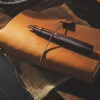
I have written in my journals almost every day for the last six or seven years. And if there is one object I would choose to pass down to the next generation, it’s them. These aren’t “dear diary” entries where I list what I ate or what time I went to bed. Instead, they are a professional and personal brain dump. Sometimes it’s a single paragraph about a thought that’s sticking with me, a “low din” I heard in a restaurant that I found beautiful, or a record of how I’m trying to solve a specific problem at the bar.
At 35, I realize how much I would give to have a handwritten record of what my father or grandfather were thinking when they were my age. To bridge that gap, I write for my son, Samuel. Looking back at an entry from shortly after he was born, I found a note describing him as “beautiful and difficult and perfect and confusing.” Reading that now, it brings back the raw emotion of that season in a way memory alone cannot.
Journaling is a tool for seeing your own evolution. Something that felt like an insurmountable struggle two years ago is often something I take for granted now. Seeing that progression gives me perspective.
For anyone struggling to start, my advice is to skip the rigid templates. Don’t worry about being “boring.” Sometimes, my entries are just a single sentence about a “jackass sales guy” ruining the atmosphere of a quiet dinner. Other times, they are deep dives into creative blocks. Whether it’s a voice note you transcribe or a pen-to-paper brain dump, the goal is the same: to leave a trail of breadcrumbs for the people who come after you, showing them that you were here, you were thinking, and you were trying to make sense of it all.

What are your three favorite restaurants/cocktail bars?
Number one is Kumiko in Chicago.The approach to ingredients is nothing short of expert. I was there a few months ago without a reservation and practically had to beg to just stand at the rail for a moment. I’m glad I did. I had a cocktail there that nearly brought me to tears—it had this incredible, plummy body, yet there wasn’t a single plum in the recipe. To be this far into my career and have a drink in front of me that makes me realize, “I didn’t even know you could do this,” is a rare and beautiful thing. I went in for one drink and ended up staying for five just to taste through the menu.
Second up is Jewel of the South in New Orleans, a city that’s one of my favorite places on the planet, and Jewel of the South is a huge reason why. The bar manager, Chris Hannah, is a legend, and sitting at his bar is a masterclass in hospitality. Their style is very different from what we do at Bar Limina: they don’t use “weirdo” ingredients; they focus on hyper-elevated, super-traditional cocktails. The food is brilliant, the space is lovely, and it just embodies the soul of the city.
Finally, Catherine and Mary’s in Memphis. This is a local gem for me. The chefs come from big Italian families in Memphis and have realized there’s a massive crossover between Italian food culture and Southern hospitality—the open arms, the focus on family, the long dinners. They combine those two worlds perfectly. What I love most about it is the versatility. My wife and I used to live around the corner; we’d pop in on a random Tuesday before a basketball game, but we also went there the night we got engaged. When a restaurant can be your casual “neighborhood spot” and your “special occasion” destination simultaneously, you’ve reached peak hospitality. It’s one of my favorite rooms in the world because it makes you feel comfortable no matter why you walked through the door.

What are your three favorite books?
Number one is easily East of Eden by John Steinbeck. It absolutely changed my life. I read it for the first time when I was eighteen, at a time when I was doing a lot of growing up, and I still revisit it almost every year. What’s incredible about Steinbeck is his ability to find magnanimous beauty in the minuscule. He can write three thousand words about a squirrel crossing a yard or the way someone’s eyes react to a whispered sentence. Reading it made me more attuned to the beauty in small, everyday things. It taught me how to notice, and I give it out as a gift constantly.
Number two is A Moveable Feast by Ernest Hemingway. A book about hanging out in restaurants and drinking wine in Paris? I am all about that. Beyond the romanticism, I love the imagery of these writers honoring the “slower pace” of work. They were sitting in cafes, sure, but they were also building masterpieces. It’s a great reminder that the “invisible” work—the thinking, the observing, the nursing of a glass of wine—is a vital part of the creative process.
And number three is Wolf by Jim Harrison. I’m a huge fan of Harrison. His work feels like a more contemporary Hemingway, soft machismo mixed with deep poetry. Wolf is especially powerful because it deals with that universal longing for something you might never actually reach. His books are unique because they often feel like they are part of the same continuous dream, set in the same locations with similar rhythms. If you’re looking to dive in, he often writes sets of novellas; you can read sixty pages and know immediately if his “seeking” style speaks to you. For me, Harrison’s work is the ultimate literary comfort food.


